

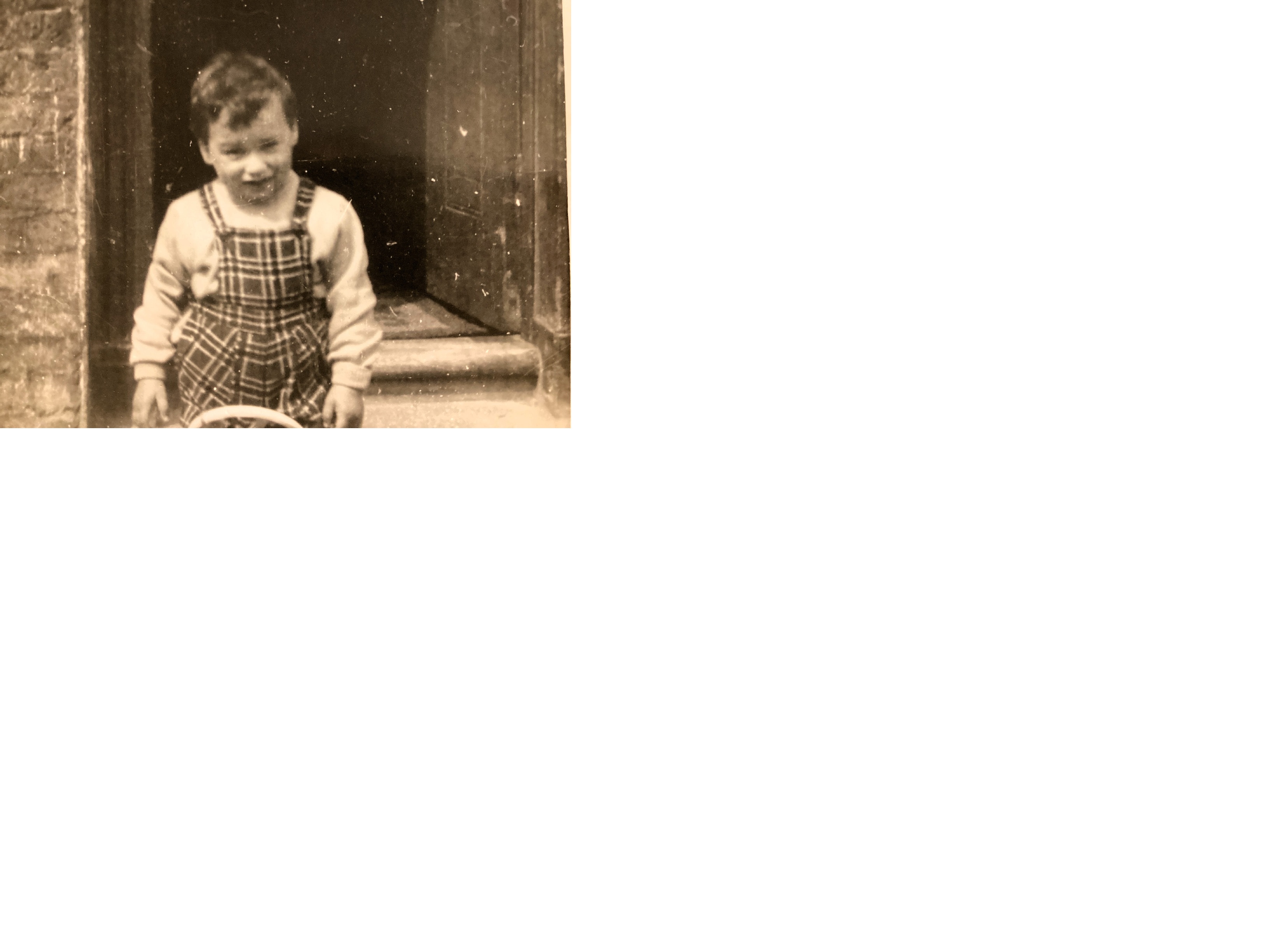
Stepney-born Andy Strowman, poet of the East End, has sent us this fascinatng reminiscence of growing up in Stepney in the 1950s, concluding with one of his poems.
My brothers Paul and Howard and I occupied one bedroom at 17 Milward Street, Whitechapel, which was behind the London Hospital.
We had three single beds and Paul was the furthest away from the door. Howard was in the middle. I was nearest the door.
Paul used to sleep with his head almost upside down so his nose was pointing in the air.
On a Saturday we would have a lie-in while Howard went to work at the weekend at Burlington Cameras in Burlington Arcade up in the West End of London.
I would wake up and lob a pillow at Paul shouting: “Wake up coconut shy!” as Paul’s head was pointing like a coconut at the fairground. By now it was half past twelve in the afternoon!
Then we would both get up and have our cereal and make our way to the municipal public baths on the Mile End Road, not far from Stepney Green station. It is now an HIV / sexual health treatment centre.
I used to look forward to our once-a-week hot bath, where I could have a sing song and talk to Paul who was in another cubicle. As you might have gathered we had no bath at home. Just a little sink in the scullery and one little coal fire in the television room. The latter was our main source of evening entertainment and if the cowboy films were on and the cowboys shooting their guns off the large mice would come out their holes and frantically dance round the room.
In that little telly room on a Friday night we used to each have our little tray of five or six monkey nuts in their shells. There was my Mum, Auntie Rae, Paul and me. My dad, a cab driver, was out working and my oldest brother Howard was out having fun up the West End.
An outside toilet in the backyard was a haven for peace – although I got frightened going out there at night and used to run out of the back door and into the toilet and vice versa!
I kept getting repeated sickness, particularly in the chest, and you can guess how cold our house was in winter.
It used to be freezing in our bedroom. We had a bucket in the centre of the room to catch the drips as they came from the ceiling.
My Uncle Davey came to visit us and I was in bed. He entered with my Mum. He looked concerned and said something in a quiet voice to my Mum. I heard a little bit of it.
“His feet are sticking out towards the door and the angel will come along and pull him out towards Heaven. We need to move his bed so his feet don’t point out like this.”
So all three beds in that room were rearranged so my feet were pointing inwards and my head was near the window so I could breathe in fresh air.
I do remember my Baba (my grandmother Milka from Vilna, Lithuania) singing to me before sleep as I was so nervous. Sadly, she died before I was two and my mother took the death very badly as must all of us. Milka was the social worker for the women of the street who came to see her with their problems.
I used to wake up in winter to see the ice had formed on the window panes. In summer I could hear the fights coming from the pub on the corner, the Oxford Arms.
My favourite was hearing “I’m a better man than you are, Paddy.”
Bang “Oh no you’re not.”
Bang
My Mum would send me there as a boy with an empty bottle and some money to get a bottle of Guinness. A man would lift me in the air where I would pass the money and empty bottle to the barmaid and in return be given a new bottle and then run home.
When I used to visit my grandmother’s best friend Byla at 15 Milward Street at the behest of my Mum it felt even colder in there. I loved to go there, though, and listen to her stories about Poland. How she washed clothes in the river for her grandparents and herself. There were many poor peasants in the village. When Byla had finished talking she would slowly open a drawer and gave me a barf of Cadbury’s dairy milk chocolate. We used to sit in the scullery, the same type of scullery we all had.
I still remember the sound of her Big Ben clock, with its black face and yellow numbers and hands, loudly ticking on the mantelpiece.
Byla was so thin but so clever. She spoke with a wobbly voice and both her eyes were bloodshot. She lived alone and walked with a stick.
Her house was the last house to be demolished and the social worker had come to her at the Jewish Hospital in Stepney Green to make her sign the papers so she ended up in care. She was put in a north London home where I pleaded with the manager to return her to Whitechapel. Byla was not pleased with me and made me say sorry to the manager, which I did. I saw her one more time. Within six weeks she had died.
Young boy’s story of the slums
Under the chimney pots
Under the sky
I wonder where in the world am I?
My voice is unison
My story is one
My hopes, my destinies…
I must have some.
I have seen
Begging looks and tried faces.
I have stood alone
In empty places.
Heavy am I in thought,
Little am I in age,
Stupid am I in sums,
And yet I know
The story of the slums.